A Family Genealogy of
the Gentle House of Stapleton
the Gentle House of Stapleton
HomeFamily ListDatabaseSurname IndexIndex of IndividualsIndex of Noble HousesFamous and Infamous People
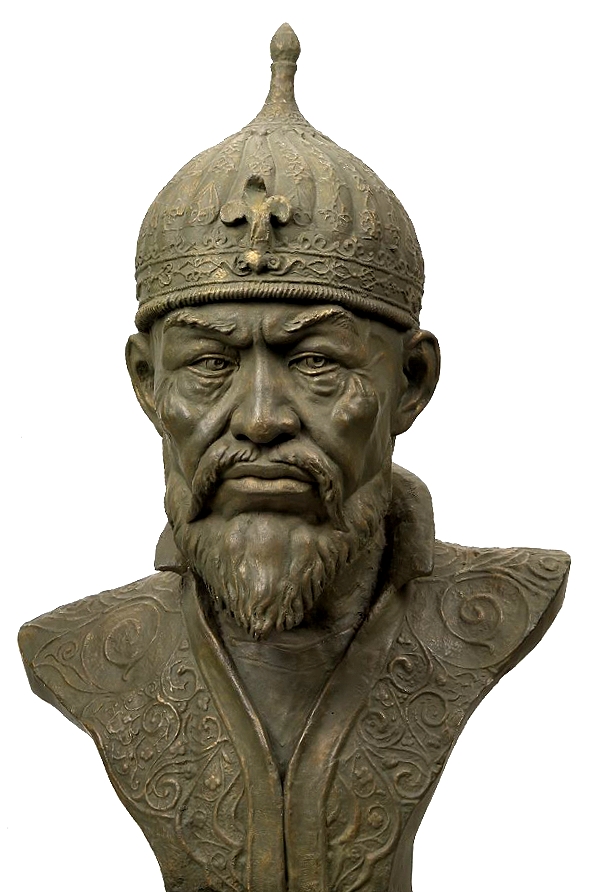
(Amir of the Timurid Empire) Timur BARLAS #83519
BET 1320 AND 1329 - ABT 17 FEB 1404/05
AKA: Tamerlane
Personal Information
- TITLE: Amir of the Timurid Empire
- BIRTH: BET 1320 AND 1329
- DEATH: ABT 17 FEB 1404/05, Farab, Timurid Empire
Notes
Founder of the Timurid Dynasty.
Timur was born in Transoxiana near the city of Kesh (modern Shahrisabz, Uzbekistan), some 80 kilometres (50 mi) south of Samarkand, part of what was then the Chagatai Khanate. His name Temur means "Iron" in the Chagatai language, his mother-tongue (cf. Uzbek Temir, Turkish Demir). It is cognate with Genghis Khan's birth name of Temüjin. Later Timurid dynastic histories claim that Timur was born on 8 April 1336, but most sources from his lifetime give ages that are consistent with a birthdate in the late 1320s. Multiple scholars suspect the 1336 date was designed to tie Timur to the legacy of Abu Sa'id Bahadur Khan, the last ruler of the Ilkhanate descended from Hulagu Khan, who died in that year.
Timur was a member of the Barlas, a Mongolian tribe that had been turkified in many aspects. His father, Taraghai was described as a minor noble of this tribe. However, Manz believes that Timur may have later understated the social position of his father, so as to make his own successes appear more remarkable. She states that though he is not believed to have been especially powerful, Taraghai was reasonably wealthy and influential. This is shown in the Zafarnama, which states that Timur later returning to his birthplace following the death of his father on 12 March 1360 AD, suggesting concern over his estate. Taraghai's social significance is further hinted at by Arabshah, who described him as a magnate in the court of Amir Husayn Qara'unas. In addition to this, the father of the great Amir Hamid Kereyid of Moghulistan is stated as a friend of Taraghai's.
In his childhood, Timur and a small band of followers raided travelers for goods, especially animals such as sheep, horses, and cattle. Around 1363, it is believed that Timur tried to steal a sheep from a shepherd but was shot by two arrows, one in his right leg and another in his right hand, where he lost two fingers. Both injuries disabled him for life. Some believe that these injuries occurred while serving as a mercenary to the khan of Sistan in what is today the Dashti Margo in southwest Afghanistan. Timur's injuries and disability gave rise to the nickname "Timur the Lame" or Temūr(-i) Lang in Persian, which is the origin of Tamerlane, the name by which he is generally known in the West.
Geographer Clements Markham, in his introduction to the narrative of Clavijo's embassy, states that, after Timur died, his body "was embalmed with musk and rose water, wrapped in linen, laid in an ebony coffin and sent to Samarkand, where it was buried". His tomb, the Gur-e-Amir, still stands in Samarkand, though it has been heavily restored in recent years.
Pir Muhammad was unable to gain sufficient support from his relatives and a bitter civil war erupted amongst Timur's descendants, with multiple princes pursuing their claims. It was not until 1409 that Timur's youngest son, Shah Rukh was able to overcome his rivals and take the throne as Timur's successor.
Timur was born in Transoxiana near the city of Kesh (modern Shahrisabz, Uzbekistan), some 80 kilometres (50 mi) south of Samarkand, part of what was then the Chagatai Khanate. His name Temur means "Iron" in the Chagatai language, his mother-tongue (cf. Uzbek Temir, Turkish Demir). It is cognate with Genghis Khan's birth name of Temüjin. Later Timurid dynastic histories claim that Timur was born on 8 April 1336, but most sources from his lifetime give ages that are consistent with a birthdate in the late 1320s. Multiple scholars suspect the 1336 date was designed to tie Timur to the legacy of Abu Sa'id Bahadur Khan, the last ruler of the Ilkhanate descended from Hulagu Khan, who died in that year.
Timur was a member of the Barlas, a Mongolian tribe that had been turkified in many aspects. His father, Taraghai was described as a minor noble of this tribe. However, Manz believes that Timur may have later understated the social position of his father, so as to make his own successes appear more remarkable. She states that though he is not believed to have been especially powerful, Taraghai was reasonably wealthy and influential. This is shown in the Zafarnama, which states that Timur later returning to his birthplace following the death of his father on 12 March 1360 AD, suggesting concern over his estate. Taraghai's social significance is further hinted at by Arabshah, who described him as a magnate in the court of Amir Husayn Qara'unas. In addition to this, the father of the great Amir Hamid Kereyid of Moghulistan is stated as a friend of Taraghai's.
In his childhood, Timur and a small band of followers raided travelers for goods, especially animals such as sheep, horses, and cattle. Around 1363, it is believed that Timur tried to steal a sheep from a shepherd but was shot by two arrows, one in his right leg and another in his right hand, where he lost two fingers. Both injuries disabled him for life. Some believe that these injuries occurred while serving as a mercenary to the khan of Sistan in what is today the Dashti Margo in southwest Afghanistan. Timur's injuries and disability gave rise to the nickname "Timur the Lame" or Temūr(-i) Lang in Persian, which is the origin of Tamerlane, the name by which he is generally known in the West.
Death
Timur preferred to fight his battles in the spring. However, he moved east via Timur's Gates and died en route during an uncharacteristic winter campaign. In December 1404, Timur began military campaigns against Ming China and detained a Ming envoy. He became ill while encamped on the farther side of the Syr Daria and died at Farab on 17 or 18 February 1405, before ever reaching the Chinese border. After his death, the Ming envoys such as Fu An and the remaining entourage were released by his grandson Khalil Sultan.Geographer Clements Markham, in his introduction to the narrative of Clavijo's embassy, states that, after Timur died, his body "was embalmed with musk and rose water, wrapped in linen, laid in an ebony coffin and sent to Samarkand, where it was buried". His tomb, the Gur-e-Amir, still stands in Samarkand, though it has been heavily restored in recent years.
Succession
Timur had twice previously appointed an heir apparent to succeed him, both of whom he had outlived. The first, his son Jahangir, died of illness in 1376. The second, his grandson Muhammad Sultan, had died from battle wounds in 1403. After the latter's death, Timur did nothing to replace him. It was only when he was on his own death-bed that he appointed Muhammad Sultan's younger brother, Pir Muhammad as his successor.Pir Muhammad was unable to gain sufficient support from his relatives and a bitter civil war erupted amongst Timur's descendants, with multiple princes pursuing their claims. It was not until 1409 that Timur's youngest son, Shah Rukh was able to overcome his rivals and take the throne as Timur's successor.
Parents
Father: Taraghai BARLAS #83518

                                             _Aylangir BARLAS ____+
                                            |
                       _Burgul BARLAS ______|
                      |                     |
                      |                     |_____________________
                      |
 _Taraghai BARLAS ____|
|                     |
|                     |                      _____________________
|                     |                     |
|                     |_____________________|
|                                           |
|                                           |_____________________
|
|
|--Timur BARLAS
|  (1320 - 1404)
|                                            _____________________
|                                           |
|                      _____________________|
|                     |                     |
|                     |                     |_____________________
|                     |
|_____________________|
                      |
                      |                      _____________________
                      |                     |
                      |_____________________|
                                            |
                                            |_____________________